How dose a website appear on the first page ?
Good on page optimization
On page optimization is all about making each page on your site super clear, super helpful and easy to follow not just for people, but for search engines too. It’s not about tricks or shortcuts. It’s about making every single part of the page do its job and support the main message you want the website to get across to search engines. When that’s all working well, it makes your content way easier to find and way more enjoyable to read, which naturally starts to make a difference to how well you rank in search results.
Your title tag & meta description are probably more important than you think. They’re the first things that show up on the results page. A clear, specific title helps search engines get a clue about what your page is about, and a decent description is more likely to get people clicking on it. Even though search engines keep telling us that meta descriptions don’t actually affect rankings, your click-through rate does – and if more people choose your result over others that’s a good sign.
Strong engagement
A high engagement rate matters, since it lets search engines know that users find your page valuable. Search engines aim to provide relevant results for users in their initial search. Since your page retains users, entices them to see more, and gets users to engage with your content, it means that your page is doing what it needs to do. Over time, this pushes your website to the top search result. A very obvious sign of engagement is how long a person stays on your page. Now, if a person clicks your result and stays on your page long enough to read your result, this means that search engines recognize that your result answers what that person was searching for. If a person immediately turns around and leaves, then this person was not satisfied with your result.
The quality of your content affects your engagement levels. If your writing is easy to understand, your use of explanation and visuals keeps your readers from straying, and your article has a good structure that provides answers, examples, and keeps readers in the know, it usually outperforms a cluttered article. If your visitor feels as though they genuinely received value from your page, their likeliest actions are to continue, share, or bookmark your page, which are all good clicks.
Site authority
A site acquires authority when search engines consider it a trustworthy, valuable source of information. This trust does not develop in a day. Instead, it develops from a reputation, through consistencies, and other signs that suggest it is liked by both users and other sites. A site that has this reputation acquires sufficient trust from search engines to rank higher in their pages, hence the significance of authority in acquiring a position in the first pages.
A major factor that determines site authority is the strength of backlinks. This refers to how many reputable sites are pointing back to your site. This can be seen as a form of endorsement, like a vote of confidence in your site. Search engines use this metric as a form of validation, determining that your site must be important since reputable sites are linking back to it. Not all backlinks are of equal value. A backlink from a reputable site can be worth ten times as much as a backlink from a low-quality site.
Brand recognition also plays a role. When searching for your site, people are searching for your brand. This is a huge trust factor. This lets search engines know that your users are familiar with your site and prefer it. This, in turn, builds your domain authority over time.
Here are 10 tips for your website
Understand search intent
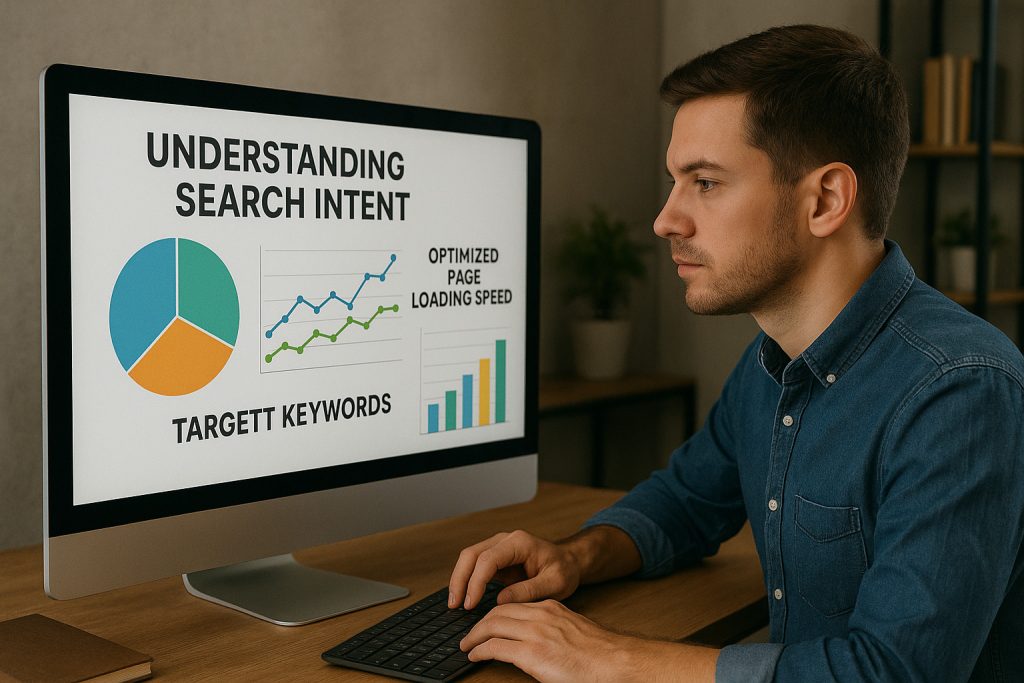
Understanding what people are searching for is, of course, the key to a successful website. Without a page that meets what people are searching for, a page full of cleverly written copy won’t matter a wit in terms of page rank. Search engines are, by definition, a means to connect a question with an answer, so the more your page meets what people are actually searching for, the higher your page rank is going to be.
It begins with understanding the intent behind a search. “How to fix a slow website” is a phrase used when a user is searching for one of three things: information, a way to fix a problem, or a product/service. The page that delivers that intent is always going to rank better than a page that doesn’t. This applies because a user searching “how to fix a slow website” doesn’t need a pitch they need a straight answer, because when people don’t find what they’re looking for, they abandon a website in a matter of seconds.
Use your target keyword in strategic areas
Use your main keyword in a natural manner, especially in key spots, and you help search engines out with what the page is about without sacrificing the quality of the reading experience. You aren’t looking to repeat this same keyword-phrase over and over again. You want to place it in those spots that make sense, so users and search engines can easily determine the topic of the page.
One of the most vital places of your main keyword is in the page title. This is what displays in search results and browser tabs, so it should clearly describe the content. Another key place for the opening paragraph is at the beginning. Early placement helps search engines confirm they’re looking at the right page, and it reassures visitors that they’ve landed in the right place. Headings are important, too using your key phrase or close variant in at least one heading shows the content structure and reinforces the topic of that webpage.In the end, natural keyword use is all about clarity. When your keyword appears in the right places, without disrupting the flow, your page just feels focused, relevant and easy to understand.
Deliver content that meets search intent
Headings are great for breaking up your content into actually readable sections. They help guide the reader and help search engines understand your page structure for a change. And trust me, pages with a simple, logical flow are way easier to rank for than ones with massive walls of text that just look overwhelming.Internal links are also pretty important. They help search engines find other pages on your site and understand how everything fits together. And they help readers get more context and move on to the next part of your site, which sends a positive signal to search engines
Visuals also matter. Images & videos should be supporting your content, not slowing it down. Other useful placements are the URL and meta description. It is easier to read a URL with the key word, and meta description can increase clicks even though it is irrelevant to the ranking.
Optimize page loading speed
Optimizing your page loading speed is a significant consideration because loading speed has a direct effect on the usability of your page by your visitors. If a page takes too long to load, most visitors don’t even bother to stay. They look for an alternative result for their search. Search engines are aware of this, which is why they don’t prefer to rank such high-loading-speed pages on top.Search engines also value page loading speed because, when optimized, it helps them showcase better results. This is because fast-loading websites are easy to crawl; thus, the engine can interpret your page and rank your content quickly.
Another consideration is the efficiency of the code. Having too many scripts, plugins, or tracking systems on a page can make it load slowly. This is fixed by eliminating unnecessary codes, as well as suppressing the use of many third-party solutions. Good web-hosting services are also essential in ensuring that a page is loading quickly enough.
Ensure your site is mobile-friendly
Making sure your site works on the phone well is no longer an option. Most people browse the web through mobile devices, and nowadays search engines judge websites mainly according to their mobile version. If it’s hard to use your site on a phone, it is likely to fall behind in search results. A mobile-friendly site adjusts smoothly to smaller screens, with text that’s easily readable without zooming in, buttons large enough to tap, and menus easy to navigate.
Mobile usability also influences trust if a site looks broken or cluttered on your phone, that screams “outdated and untrustworthy” And, at a minimum, strong content becomes frustratingly hard to consume. It’s worth pointing out that search engines pay attention to this because it aligns with their mission: sending users onto pages likely to work in the real world.
Create easy-to-follow internal links
Clear internal linking will help users and search engines understand your website better. Internal links are the connections from one page of your site to another, and where they work, they smoothly guide visitors from topic to related topic. This makes a site easier to use and keeps people on your site longer. From the perspective of a user, internal linking is directional; they help readers to get other related information without going to search it again or leaving the site altogether.
Search engines also use internal links as an indicator of structure. Internal links help them find new pages and judge how various topics relate to one another.Internal linking also allows one to distribute authority throughout the site. Strong pages can pass value onto newer or less visible ones, helping rank them better over time. This creates some level of balance and prevents important content from being buried.
Maintain fresh and relevant content
Keeping your content fresh means keeping your site up-to-date, relevant and useful in the long-term.Keeping your content fresh means keeping your site up-to-date, relevant and useful in the long-term. Fresh content doesn’t necessarily mean creating something from scratch. It can be equally effective to update old pages. Add new information, further explain something, or adjust a section because the information in your industry is changing. Updates like these serve to show the search engines your site is alive and well cared for.
Fresh content helps users, too. When visitors see that information is recent, they’re more likely to trust your site. Outdated facts, broken links, or old examples make a page feel neglected and unreliable. Even small updates can enhance how users feel about your brand.
Design user-friendly URLs
Using clean descriptive URLs is a huge plus when it comes to making your website understandable for visitors, as well as for the Search Engines. The best part is that a URL is the very first thing that people see before clicking on a result, which is why a clean and understandable URL plays an essential role in setting the right expectations. An ideal URL should make use of real words, but not random numbers or symbols. For instance, a URL that corresponds with the topic of the page is far more useful than a URL that is full of codes. This is because such a URL helps search engines easily identify the topic of the page, thus assisting with better ranking.
It is also useful to include a relevant keyword inside the URL, provided that it is a natural fit. This is a further small signal that helps confirm what the page is all about. It is unnecessary to include multiple keywords inside a single URL. This is all that is required. Clean URLs make it easier to organize your site. This is because a sound structure means that your site can be crawled by search engines more efficiently, which means that viewers can navigate your site with more assurance.
Secure quality backlinks
The most significant methods of establishing authority and building better rankings on search are earning reputable backlinks. A backlink is a link coming from another website to your pages. The search engines view these links as endorsements: when a site that is trustworthy links to your content, then that is an indication that your page is of value and credible. More than that, backlinks allow search engines to find new pages and make sense of your website’s context. If many other trusted sites link to your content, this will result in a much higher level of overall credibility and trust in your site from the algorithm.
Links derived from high-quality and relevant websites can immensely be more valuable than links coming from low-quality or unrelated sites. One link coming from an authority may serve better than dozens of weak links. That is why quality will always be more important than quantity.
Review what’s performing well
Monitoring what’s working on your website is important for performance improvement and making wiser decisions. Without monitoring results, you’re basically guessing what works. By keeping track of metrics, you see which pages are bringing in visitors, what keeps them engaged with the content, and which need further improvement. With the use of tools such as Google Analytics and Search Console, this gets a lot easier.
Regularly reviewing the data lets you in on where to make informed updates. You can double down on what works, adjust what doesn’t, and continuously refine your website. In short, tracking what’s working will help you focus on actions improving performance, user experience, and search visibility.